
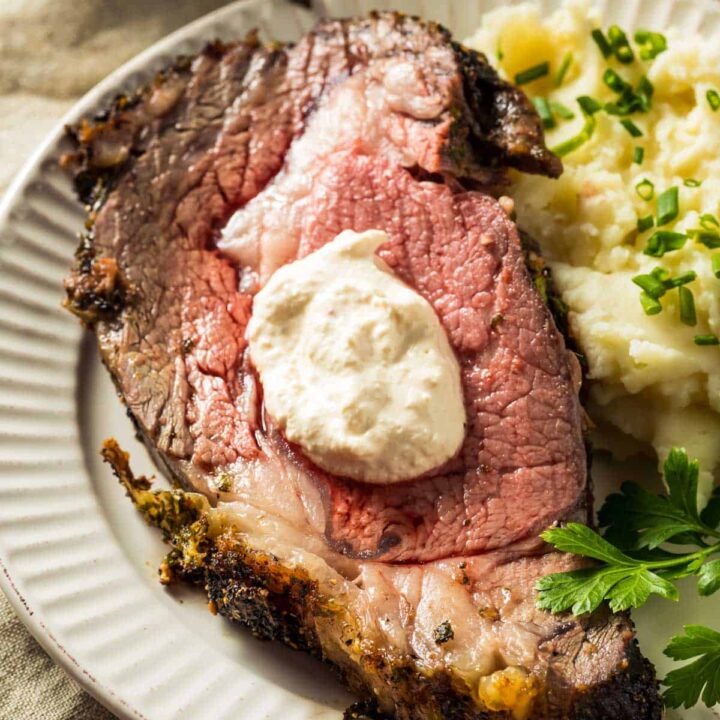
A perfectly cooked boneless prime rib is the perfect holiday main dish. With its tender texture, rich marbling, and garlic-herb crust, this simple recipe makes any gathering feel like a celebration!
Making prime rib at home is much simpler than you might think. With just a few pantry ingredients and a meat thermometer, you can serve a juicy, restaurant-quality roast at home. This boneless prime rib recipe creates a beautifully browned crust on the outside while keeping the inside tender and flavorful, which is perfect for Christmas dinner, special occasions, or whenever you want to impress your guests without the stress!
Quick answer: How to cook a boneless prime rib
Roast at 450°F for 20 minutes, then lower to 325°F and cook about 15-20 minutes per pound until a leave-in thermometer in the center reads your pull temperature. Remove it from the oven, tent it with foil, and let it rest for 20-30 minutes (the temperature will rise another 5-10°F while it rests).
Rare: pull at 115-120°F → about 120-125°F after resting
Medium-rare: pull at 125°F → about 130-135°F after resting
Medium: pull at 135°F → about 140-145°F after resting
An 8-lb roast takes roughly 2 ½ - 2 ¾ hours for medium-rare. Start checking the temperature about an hour before that, or better yet, use a meat thermometer with an alarm set to your preferred temperature. That's what I've used for years and it really takes the stress out of having to constantly check it, and you can see the temp it's at a a glance.
Tip: The temperature will go up very slowly in the beginning, then it will rise much quicker as the center of the roast heats up. This is why checking it often once it's close to your target temperature is important, as it changes quickly at that stage.
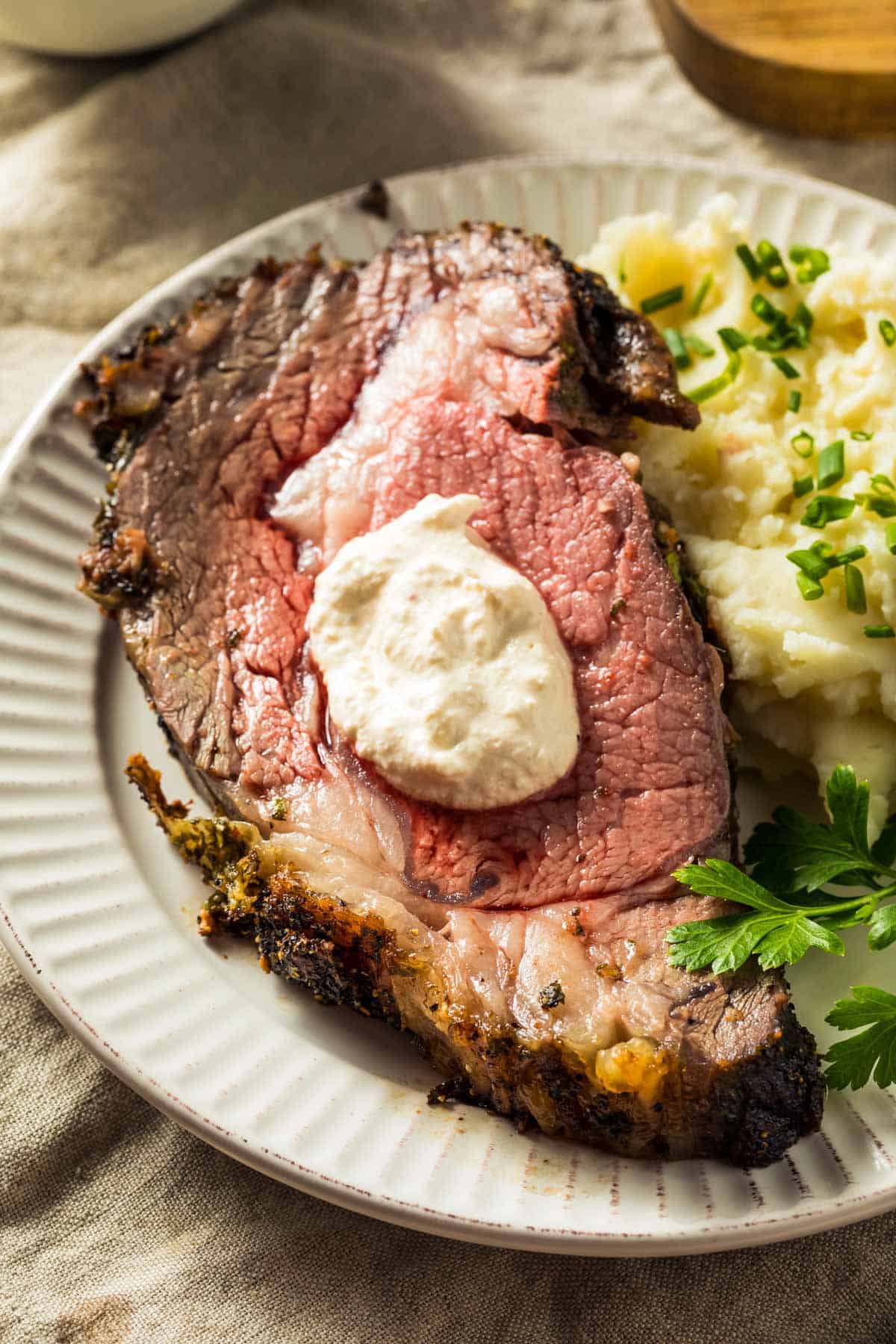
The prime rib recipe is always the one we use whenever we've got a boneless prime rib roast (which is at least every Christmas). I always serve it with horseradish sauce along with the au jus.
If we have a bone-in roast, we make our standing rib roast (it's called that because the bones allow it to "stand"). Both rubs can be used interchangeably (this one is herbs and garlic; the other is mustard, garlic, and peppercorn, so choose your favorite)! Both are incredible when served with green beans almondine and/or homemade creamed corn.
Jump to:
Ingredient Notes And Substitutions
The rub is simple, but a few swaps change how the crust turns out. Here are some tested ideas for what you can change to tailor it more to your tastes:
- The roast: Look for a boneless rib roast (I've also seen it labeled as boneless ribeye roast or beef rib roast). This recipe is written for an 8-pound roast. For a smaller one, scale the rub down: a 4-pound roast needs about half the herb butter (if it's larger, you can use the built-in ingredient adjuster in the recipe card below). If you have a bone-in roast, use our standing rib roast instead, since the bones change the cooking time.
- Fresh herbs: Fresh herbs give the crust its color and flavor, and they're worth buying for a roast this special. If you need to use dried, only use about one-third the amount (1 teaspoon dried for every tablespoon fresh). Dried herbs can taste a little dusty in a butter rub, so if you have even one fresh herb on hand, use it and fill in the rest with dried. And I can't stress enough how much better it will be if you're able to use fresh!
- Tarragon: Tarragon is an underused and underrated herb in my opinion (probably because it's one of my favorites). It adds a subtle, slightly sweet anise note that sets this rub apart from a standard garlic-herb butter. If you can't find it or don't love that flavor, you can replace it with more parsley and an extra tablespoon of thyme. You can also use 1 teaspoon of dried tarragon in place of the fresh.
- Garlic: Fresh minced garlic is best. If you don't have any fresh garlic, use ½ teaspoon garlic powder in place of the 4 cloves. I don't recommend using jarred garlic as it's just not potent enough, so it's worth taking the extra step of mincing fresh garlic for an expensive roast.
- Salt: This recipe uses coarse salt (I use Morton kosher salt). If you're using table salt or fine sea salt, cut the amount roughly in half, because fine salt packs more tightly into a spoon and it will be too salty.
- Butter: Unsalted butter lets you control the seasoning. If you only have salted butter, reduce the added salt by about 1 teaspoon.
Worried about smoke? Butter can smoke at 450°F, especially in an oven that isn't perfectly clean. Here are three fixes:
- Use ghee, which has a higher smoke point than butter.
- Make the herb paste with olive oil instead of butter. A reader who made it this way reported great results.
- Add a cup or two of water or wine to the bottom of the roasting pan. Another reader's tip: it keeps the drippings from smoking and gives you a head start on au jus.
Dairy-free: The olive oil version works here too. Use about ⅓ cup of olive oil in place of the butter to make a thick, spreadable paste.
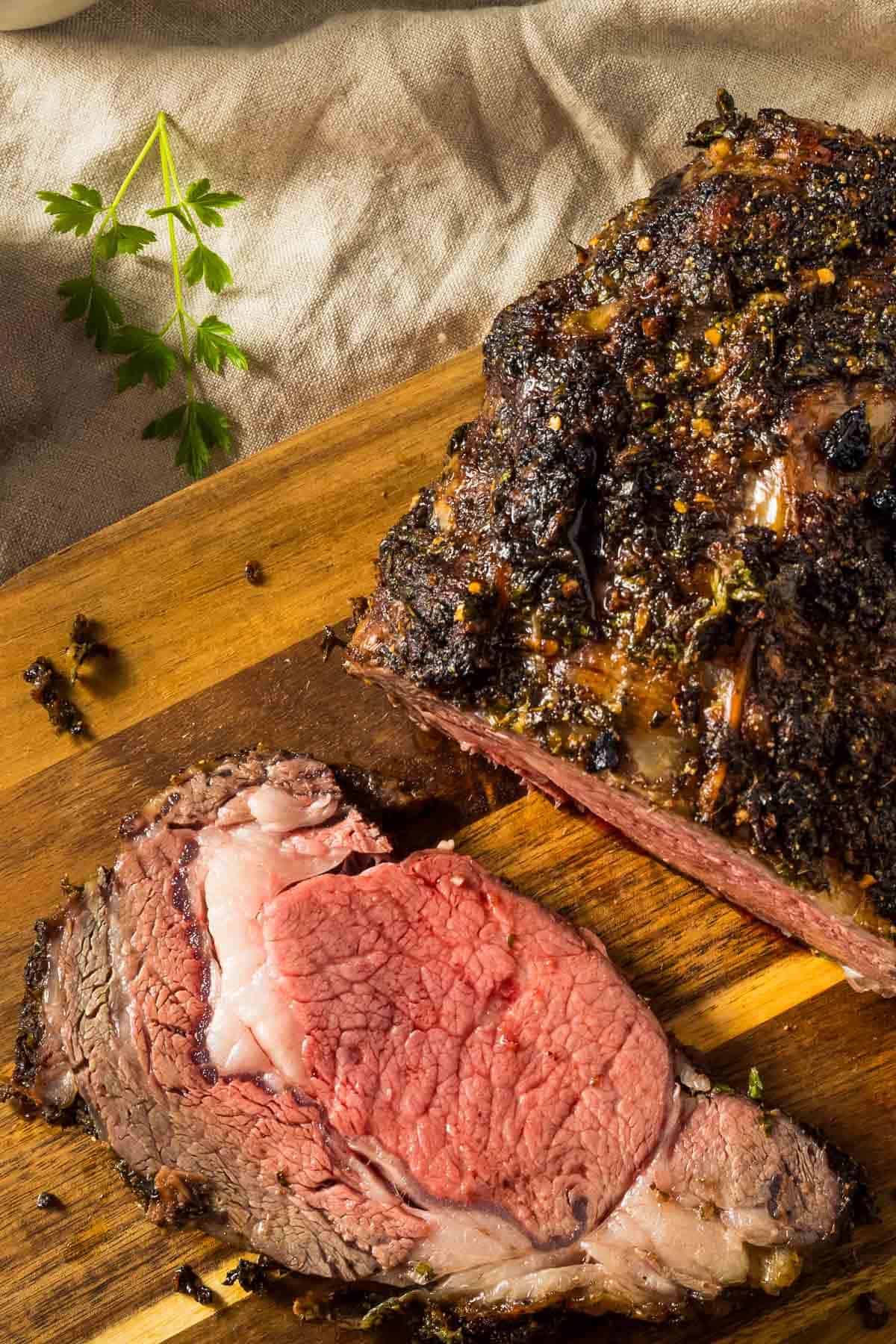
How to Make This Boneless Prime Rib Recipe
Boneless prime rib is one of the easiest, low-stress entrees you can make for the holidays. Here are the exact steps to follow so it turns out perfect every time:
- Bring the roast to room temperature: Take the roast out of the refrigerator 1 to 2 hours before cooking and let it sit uncovered on the counter (this will help it cook more evenly from the edges to the center). If the roast is tied, leave the twine on. (Now is also a good time to remove your butter from the fridge to let it soften at the same time).
- Preheat the oven: Set the oven to 450°F with a rack in the lower-middle position, so the roast sits in the center of the oven. Place a rack inside a roasting pan to hold the roast above the drippings. If your oven tends to smoke, pour a cup or two of water or wine into the bottom of the pan now.
- Make the garlic-herb butter: In a small bowl, mash together the minced garlic, chopped herbs, salt, pepper, and softened butter until it's evenly combined. It should be thick and spreadable.
- Pat dry and season the roast: Pat the roast completely dry with paper towels (a dry surface browns better and helps the butter stick). Rub the herb butter all over the top and sides, pressing it in so it forms an even layer.
- Set it fat side up and insert the thermometer: Place the roast on the rack, fat side up, so the fat bastes the meat as it melts. Insert a leave-in thermometer into the thickest part of the roast, aiming for the very center (try to avoid any pockets of fat).
- Start with high heat: Roast at 450°F for 20 minutes to brown the outside and get a head start on the crust.
- Lower the heat and roast until it reaches your pull temperature: Reduce the oven to 325°F without opening the door. Keep roasting until the thermometer reads your pull temperature, which is 5 to 10°F below your target doneness (the roast will keep cooking as it rests):
- Rare: pull at 115-120°F
- Medium-rare: pull at 125°F
- Medium: pull at 135°F
- Plan on about 15 to 20 minutes per pound after the initial sear, and use the chart below to estimate your timing. Start checking about an hour before the estimated finish time. Every oven and every roast is different, and it's much easier to wait a little longer than to rescue an overcooked roast.
- Rest the roast: Transfer the roast to a carving board, tent it loosely with foil, and let it rest for 20 to 30 minutes. The internal temperature will rise another 5 to 10°F, and the juices will settle back into the meat instead of running out when you slice it (save the drippings in the pan if you're making au jus).
- Carve and serve: Remove any twine. Slice across the roast (against the grain) into ½- to 1-inch thick slices. The end pieces will be more well done than the center, which is perfect for anyone who prefers their prime rib less pink. (This actually works out great for our family, because my dad wants his prime rib without any pink, so he always gets the end slices. The rest of happily fight over the middle)!
Cooking Time Chart
Cooking times will vary depending on the size of your roast and your oven, so always use a meat thermometer for accuracy. The times below are estimates based on roasting at 450°F for the first 20 minutes, then lowering to 325°F until it's done.
| Roast Weight | Rare (120–125°F) | Medium-Rare (130–135°F) | Medium (140–145°F) |
|---|---|---|---|
| 4 lbs | 1 hr 15 min – 1 hr 30 min | 1 hr 30 min – 1 hr 45 min | 1 hr 45 min – 2 hrs |
| 6 lbs | 1 hr 45 min – 2 hrs | 2 hrs – 2 hrs 15 min | 2 hrs 15 min – 2 hrs 30 min |
| 8 lbs | 2 hrs 15 min – 2 hrs 30 min | 2 hrs 30 min – 2 hrs 45 min | 2 hrs 45 min – 3 hrs |
| 10 lbs | 2 hrs 45 min – 3 hrs | 3 hrs – 3 hrs 15 min | 3 hrs 15 min – 3 hrs 30 min |

Equipment Needed
- Roasting pan with rack: a rack will elevate the roast so air circulates evenly and any drippings collect underneath.
- Leave-in meat thermometer: the single most important tool for perfectly cooked boneless prime rib! This is what makes it completely stress-free. I use one with a built-in alarm that alerts me once the internal temperature of the roast has been reached. I can also see the temperature as it rises, making it much easier to plan when to start cooking side dishes.
- Sharp carving knife: make sure it's sharp for slicing clean, even portions.
- Cutting board (with juice groove if possible): for resting and carving the roast without making a mess.
Tips for Buying a Boneless Prime Rib
- Know the names: Boneless prime rib may also be labeled as beef rib roast, boneless ribeye roast, boneless rib roast. If it says standing rib roast, that means it's a bone-in roast and is not used in this recipe (this is our recipe for a standing rib roast if you'd prefer bone-in). If you're unsure, ask your butcher to confirm you're getting the correct cut.
- Understand USDA grades:
- Prime: Highest grade, heavily marbled, tender, and flavorful. Often found at specialty butchers or online retailers.
- Choice: More widely available, with good marbling and excellent flavor (this is what most home cooks buy).
- Select: Leaner, less marbling, and not recommended for prime rib since it won't be as juicy or tender.
- Portion size: Plan for about:
- ½ pound per person if serving with multiple sides.
- ¾ pound per person for fewer sides.
- 1 pound per person if you want generous portions or leftovers (great for sandwiches).
- Fresh vs. frozen: Fresh is ideal, but frozen prime rib can be a good option if it's bought in advance. Thaw it in the refrigerator for several days before cooking.
- Look for marbling: Choose a roast with even marbling (thin streaks of fat throughout the meat). The fat melts during cooking, and makes for a more juicy and flavorful roast.
- Time your purchase: Around the holidays, boneless rib roasts often go on sale. Buy yours just before cooking, or purchase it early and freeze it if you find a great deal.
- Ask your butcher: A good butcher can trim any excess fat, tie the roast for even cooking, and recommend the right size for the number of guests.
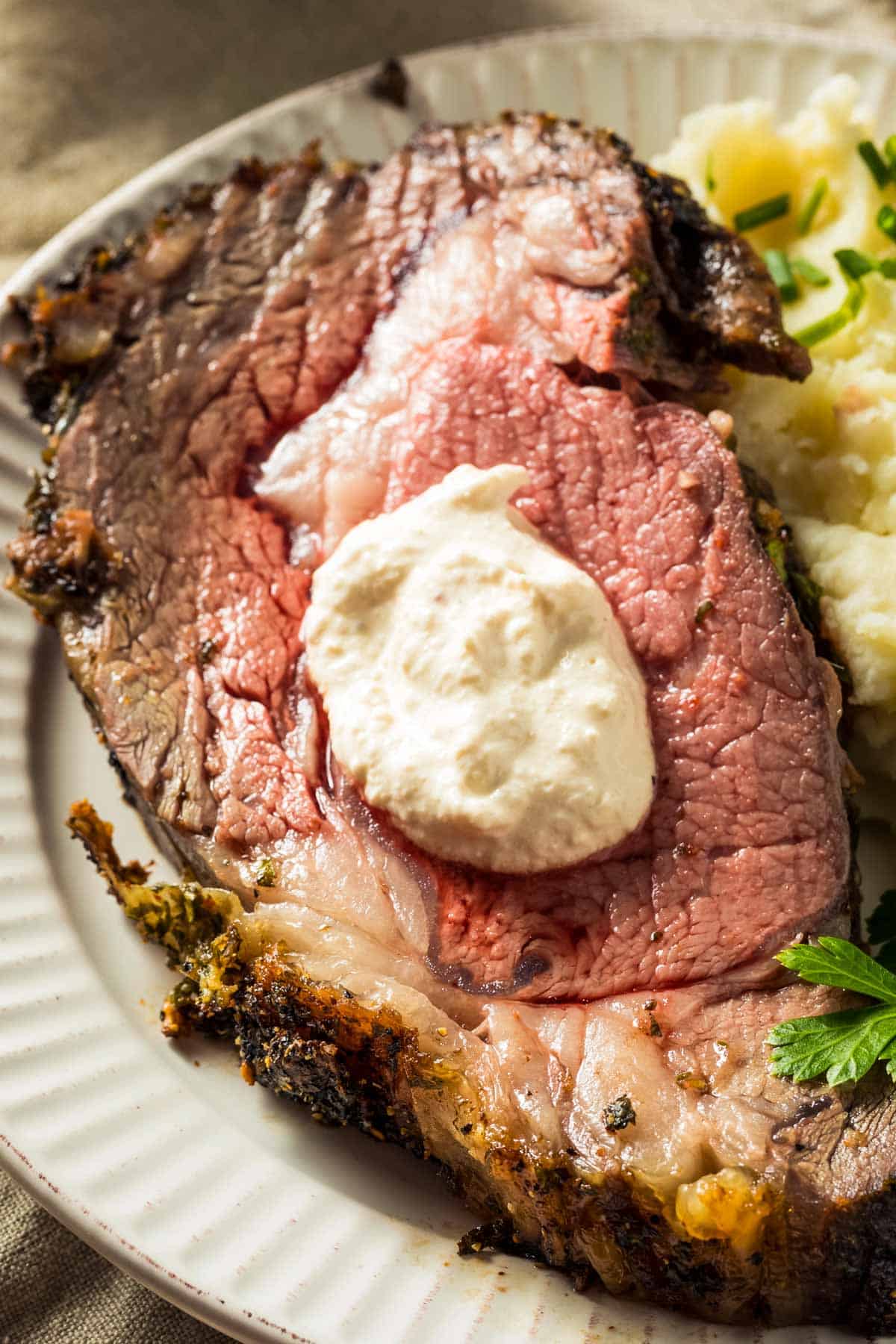
Storage & Reheating
Storage
- Refrigerator: Store leftover boneless prime rib in an airtight container or tightly wrapped in foil for up to 4 days. Slice only what you plan to eat so the rest stays juicy.
- Freezer: Wrap cooled slices tightly in plastic wrap and then foil, or use a freezer-safe container. Freeze for up to 2 months. Thaw overnight in the refrigerator before reheating.
Reheating
Prime rib is best when it's reheated gently. High heat can overcook the meat and make it tough, so go low and slow.
- Oven: Preheat oven to 250°F. Place slices in a baking dish with a splash of beef broth or au jus, cover with foil, and heat until it's warmed through (about 15-20 minutes depending on its thickness).
- Stovetop: Heat slices gently in a skillet with a bit of beef broth over low heat, covering it with a lid to keep the meat from drying out.
- Sous vide (ideal for keeping medium-rare): Seal slices in a vacuum bag or zip-top bag and heat in a 135°F water bath for about 1 hour.
- Microwave: Use low power in short intervals (20-30 seconds), adding a splash of broth and covering with a microwave-safe lid to retain moisture.
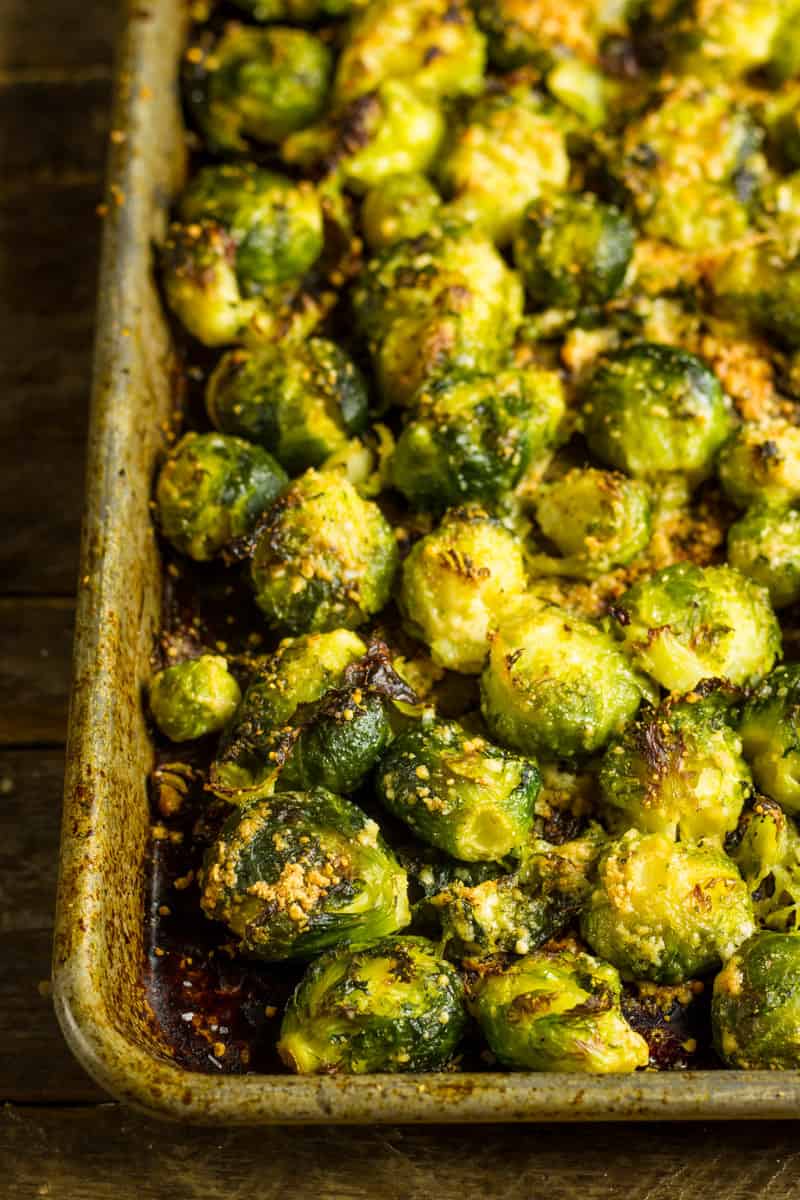
What to Serve With Boneless Prime Rib
These are the dishes we love to serve with this boneless prime rib recipe:




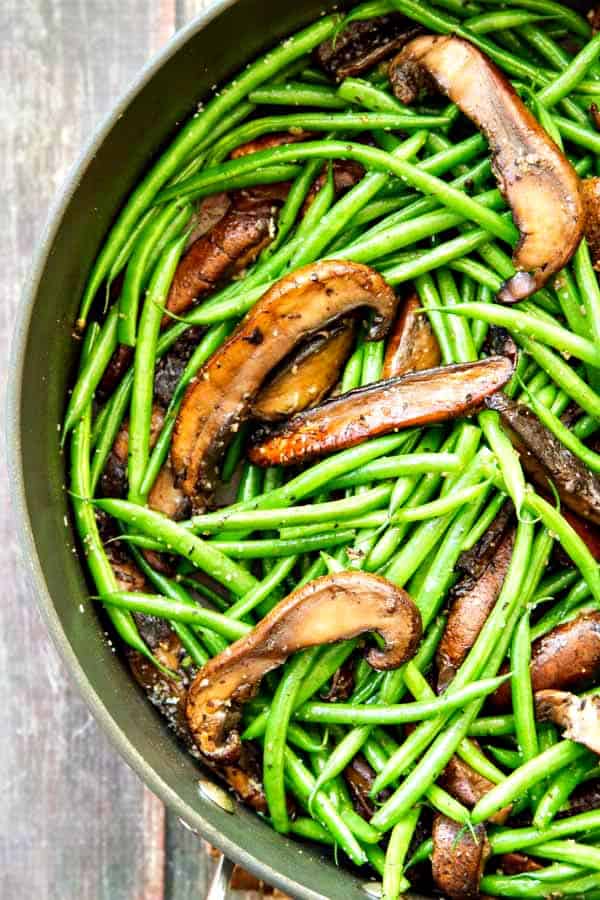
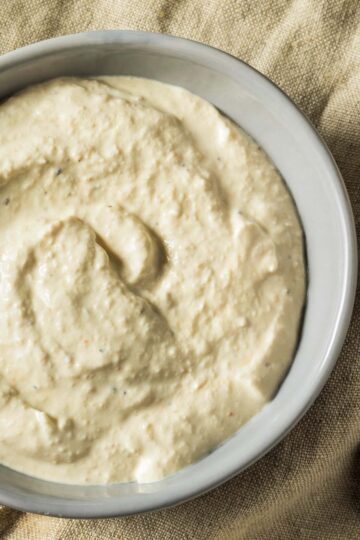
Frequently Asked Questions
Do I need to tie a boneless prime rib before cooking?
it's often tied with butcher's twine to help it cook evenly and maintain its shape. Your butcher can do this for you, but your roast will turn out just fine if it's not tied, so don't stress over it (we usually skip this step).
What temperature should boneless prime rib be cooked to?
Rare: 120-125°F
Medium-rare: 130-135°F
Medium: 140-145°F
Always use a meat thermometer for accuracy!
Why is prime rib served rare to medium-rare?
Cooking to medium-rare keeps the fat from melting away, which makes for more juicy, tender meat. The end pieces will naturally cook a bit more, which is great for guests who prefer medium or medium-well.
How long do you cook a boneless prime rib?
As a rule of thumb, plan on 15-20 minutes per pound after the initial high-heat sear at 450°F. Always check for doneness with a meat thermometer instead of relying only on time.
Can I make boneless prime rib ahead of time?
It's best served fresh from the oven after a 20-30 minute rest. However, leftovers reheat well (see Storage & Reheating above), so you can definitely make it ahead of time following those instructions.
Herb-Crusted Boneless Prime Rib Roast
If you think making prime rib is difficult, I'm here to tell you how simple it is! Make sure to use a leave-in meat thermometer for perfect results every time.
Ingredients
- 1 8-pound boneless rib roast
- 4 garlic cloves, minced
- ¼ cup chopped fresh tarragon
- ¼ cup chopped fresh parsley
- 3 tablespoon chopped fresh thyme
- ⅓ cup chopped fresh rosemary
- 1 tablespoon coarse salt
- 2 teaspoon freshly ground black pepper
- ½ cup butter, softened
For the Au Jus
- Pan drippings from your cooked prime rib
- 1–2 cups beef broth (low-sodium)
- ½ cup red wine (optional but adds a lot of flavor)
- Salt & freshly ground black pepper, to taste
Instructions
- Take the roast out of the refrigerator 1 to 2 hours before cooking and let it sit uncovered on the counter. This is also a good time to take out your butter and let it soften.
- Set the oven to 450°F with a rack in the lower-middle position, so the roast sits in the center of the oven. Place a rack inside a roasting pan to hold the roast above the drippings. If your oven tends to smoke, pour a cup or two of water or wine into the bottom of the pan now.
- In a small bowl, mash together the minced garlic, chopped herbs, salt, pepper, and softened butter until it's evenly combined. It should be thick and spreadable.
- Pat the roast completely dry with paper towels. Rub the herb butter all over the top and sides, pressing it in so it forms an even layer (the "fat side" is the top).
- Place the roast on the rack, fat side up. Insert a leave-in thermometer into the thickest part of the roast, aiming for the very center and avoiding any pockets of fat.
- Roast at 450°F for 20 minutes.
- Reduce the oven to 325°F without opening the door. Keep roasting until the thermometer reads your pull temperature:
Plan on about 15 to 20 minutes per pound after the initial sear, and use the chart in the post to estimate your timing. Start checking about an hour before the estimated finish time. Every oven and every roast is different. - Transfer the roast to a carving board, tent it loosely with foil, and let it rest for 20 to 30 minutes. The internal temperature will rise another 5 to 10°F, and the juices will settle back into the meat instead of running out when you slice. Save the drippings in the pan if you're making au jus.
- Remove any twine. Slice across the roast (against the grain) into ½- to 1-inch thick slices. Serve with horseradish sauce or au jus (or both)!
For the Au Jus
- After removing the roast from the pan, pour the drippings into a heatproof measuring cup. Let them sit for a few minutes so the fat rises to the top. Skim off most of the fat.
- Place your roasting pan over medium heat on the stovetop. Pour in the red wine (if using) or a small amount of the beef broth, scraping up any browned bits from the bottom of the pan.
- Stir in the beef broth and the reserved drippings, then simmer for about 5 minutes or so.
- Pour the au jus through a fine-mesh strainer into a serving bowl or gravy boat.
- Season with salt and pepper as needed. Serve warm alongside the prime rib.
- Note: If you like a slightly thicker au jus, whisk 1 teaspoon cornstarch into 2 tablespoons cold water and stir it in during the simmering step.
Notes
Try this recipe if you prefer horseradish sauce with your prime rib.
Nutrition Information:
Yield: 16 Serving Size: 1Amount Per Serving: Calories: 116Total Fat: 8gSaturated Fat: 5gUnsaturated Fat: 4gCholesterol: 23mgSodium: 400mgCarbohydrates: 7gFiber: 3gSugar: 0gProtein: 3g
This data was provided and calculated by Nutritionix. It's based on 16 servings and includes the au jus.

- Horseradish Sauce For Prime Rib - September 29, 2026
- Whole Oven Roasted Onions (+ 33 Ways to Use Them!) - January 6, 2026
- Easy Tater Tot Casserole - December 19, 2025
Lauren says
Hi!
How would you adjust this recipe for a bone-in prime rib? I saw the link for the other recipe but this recipe is what we typically use and love! Thank you!!
Monique McArthur says
Follow the instructions exactly except reduce the heat to 350°F. As long as you're cooking to an internal temp of 130°F it should come out perfectly. Hope you enjoy.
Lauren says
@Monique McArthur,
Thank you so much! Merry Christmas
Penny says
I am going to make this for Christmas dinner this year. However, my husband ordered a boneless prime rib for Christmas. We just found out tonight that it will be here Monday. I thought it would be here right before Christmas not a week early. The dilemma is that my husband says that it will be okay until Christmas in the fridge. Since Christmas is a week away, I think we should freeze it. What are your thoughts?
Monique McArthur says
Hi, According to the FDA you should only refrigerate up to 3 to 5 days and freeze anything beyond that.
Donna says
Highly recommend! I’ve been preparing Prime Rib for over 50 years and decided to try a new recipe. So glad I did, won’t go back to my former method. Thank you for sharing!
Brian Williams says
Every year for Christmas or New Year I've made this prime rib recipe since I first met Kristy back in 2014. I was traveling this year so I passed it on to a few friends to try. One family made it yesterday and came into the office raving about how delicious it came out and how easy it was to make. I took the credit of saying I have a great recipe that I got from an even better friend!
Kristy Bernardo says
Aww, love this so much, Brian! Miss you and your wonderful family!
Kathy Ridenour says
I made this for Christmas dinner and it was tender, moist, and very flavorful. This is now saved under my favorites so we can make it every year. I was a little nervous about getting the degree of doneness correct but using a meat thermometer was the key.
Cathy says
Does the butter make it smoke a lot? We have trouble with our vent fan and I have to be careful not to get smoke in the kitchen or all the alarms go off. Other than that... this sounds wonderful!
Kristy Bernardo says
Hi Cathy! I've never noticed it smoking but our vent fan works well, so I'm not sure how to advise you on this. I did happen to see a comment this morning left on the Pinterest pin from someone who made it recently; they said that they made a paste out of the garlic and herbs with olive oil in lieu of the butter. That might be a safer route for you. There's also a link in the post above to a garlic-peppercorn rub that I use often as well. Hopefully one of those will pique your interest. Let me know if you try it!
MARK says
@Kristy Bernardo, put a cup or 2 if water or water/wine in the bottome of the roaster. It keeps the fat from smoking and jump starts you Au Jus.
Susie Palmer says
I made this and it was PERFECT